Use icons to teach what you stand for
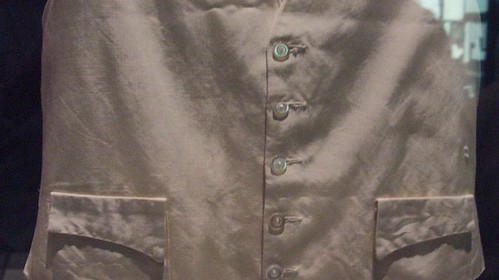
Gene Kranz's waistcoat

Every organisation has a story

Every organisation has a story. Why it was started, who were the founders, the first product, key characters and occasions along the way, adversities overcome, game changing meetings. Every day adds a few more paragraphs. But when you’re involved in the tale, it’s easy to get buried in day-to-day detail and lose the thread.

Highlighting and celebrating iconic stories that stand for your spirit brings everyone together and teaches them how to act — who hasn’t learned the importance of resourcefulness, determination and creativity through Edison’s famous story of 1,000s of failures on the way to incandescent success.

Some of the sharpest stories are wrapped around a tangible icon.

The worlds most famous waistcoat

For instance, the picture above is of the worlds most famous waistcoat, worn by Gene Kranz throughout the failed Apollo 13 Moon mission in 1970. The Smithsonian’s National Air and Space Museum, in Washington DC, displays it with this explanation:

Eugene F. “Gene” Kranz, Chief of NASA’s Flight Control Division, wore this suit vest during Apollo 13, the third planned lunar landing mission. While the spacecraft was going to the Moon, an explosion occurred in its service module. Mission Control aborted the Moon landing and worked with the ground support team of astronauts, technical experts, and aerospace contractors to solve several key problems and to bring the crew back safely.

As the leader of Mission Control’s “white team,” Kranz wore a different white suit vest for each mission from Gemini 9 in 1966 through Apollo 17 in 1972. He wore plain vests, like this one, during the missions; he reserved fancier versions for celebrating mission completions. All were hand sewn by his wife.

Although Kranz’s trademark vests were well known at the time, his portrayal by actor Ed Harris in the blockbuster 1995 film Apollo 13 made this particular vest iconic.

As was the custom in Mission Control, “white” was retired from flight team colors after Kranz’s retirement.

Gift of Eugene F. Kranz Family

My favourite scene in Ron Howard’s movie is a meeting called to work out how to keep Apollo 13’s crew alive and return them safely to earth. Kranz lays out the problem with a picture and asks the room for ideas. Everyone starts talking at once, opinions are flying, each person shouting over the other.

Kranz stands in the middle of all this chaos wearing his pure white waistcoat like a beacon of order, discipline and possibility. He keeps bringing the team back to the problem, pushing for answers, being decisive and demanding in turn. This “failure is not an option” scene happened for real and is a model of teamwork and leadership under pressure.

Icons are shorthand

Everything I know about the spirit of NASA is symbolised by that white waistcoat. Hearing the story, even the rawest of recruits can’t fail to learn the keys to success: high motivation, discipline, goal orientation, whatever-it-takes attitude, trust in the team, collaboration, demanding leadership.

Whilst not every team is playing for the same stakes as Apollo 13’s Mission Control, and few leaders are blessed with Kranz’s feeling for symbols or occasion, with a little bit of thought every company can find its icons.

What are yours?

You can hang them in reception, name company awards after them, tell the stories at all-hands events, use them to induct new staff.

An old waistcoat may not be the most common example, but stories wrapped around iconic visual aids are the quickest and most effective way of getting everybody pointed in the same direction and acting together.

What about you?

What icons does, or could, your company use? What have you seen other companies using?

Or, is this wrong headed, pandering to yesterday when it’s only today that matters?

Neatly filed under Foundations
Tags: ,

Why don’t customers buy your product?

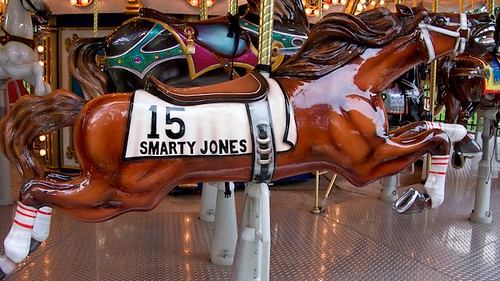
Smarty Jones at Glen Echo Park

A little bit lost in Maryland this summer, my family and I came across Glen Echo Park, a once popular destination that’s seen hard times and is on the way back through the involvement of a dedicated not-for-profit tribe of volunteers.

Most of our visit was spent at the carousel where I was smitten with Smarty Jones. Mmmh, mmh that’s a handsome looking horse – if I’d have been riding I’d have taken Smarty for a trot for sure.

But for the whole time we were at the park, not one child rode Smarty.

What’s wrong?

Why don’t some customers buy your product? If it’s anything like Smarty, it’s great: accessible, goes up and down, has all the features, stands out in a crowd, it’s super-shiny for goodness sakes.

So why does the turkey get a ride whilst good ol’ Smarty puts on a brave face?

It’s the kind of question I get asked all the time. “We have a great product, but there something wrong. What is it?”

Whilst every product has it’s own story, the tale is put together the same way every time — and anyone can do it.

Ask your customers

Act like a consultant and ask your customers. You’ll learn more from what goes wrong than what goes right so make sure to ask non-customers who’ve made an active choice not to buy, and actual-customers who’ve bought but have stopped using. Get out of the building and ask the people who know. Visit, lunch, interview, test, survey — whatever it takes to get the information you need.

Speak to enough customers to see patterns; some will point to lack of priority or urgency, others may point to weaknesses in your product or your proposition. Assume nothing, test everything. When you’re pretty sure you know what’s going on, it’s time to act on what you’ve found.

What are you going to do about it?

There are three layers where you might need to fix things inside the building:

  • Message problems are easiest and cheapest to solve. Get together with your sales and marketing team and change your presentations, messaging, communications. Use A/B testing to see what changes work best — especially if you’re web based and have a lot of passing trade.
  • Go-to-market problems are more strategic and will probably force a new look at your market, features, distribution, pricing and positioning choices. Everything in this layer is connected so be suspicious of anything that looks like a silver bullet.
  • A weak or ill defined core proposition means a fundamental rethink and the discomfort of living with your current product whilst working back through first principles.

After two interviews (my own children, 40% of the carousel kids that day) it was pretty easy to work out Smarty’s problem. Too much competition and a very small market. Strategic problems with no answer in sight means old Jones could be racing to retirement.

What about you? Can you change priorities and raise urgency or do you have to go a little deeper?

Neatly filed under Foundations, Making Promises, Skippiness
Tags: , , , ,

Finding your champion

Paula

What happens when prospects don’t say Yes and won’t say No?

A Maybe is a hole in time. Complex products live with decision cycles that can last longer than a dying star. Entire companies have disappeared into Maybe shaped black holes. Listen carefully and you can hear them screaming “Just one more meeting, and I think we’re theeerrrreeeee…” as they fall across the event horizon.

It’s not always a problem. In a must-win, absolutely-no-choice, do-whatever-it-takes-to-keep-the-lines-open, a Maybe is the bread of life. If you’re operating bespoke — a new kind running shoe specially made for Paula, say — then you’re mission bound to keep the door cracked open.

Sometimes a Maybe isn’t even on the cards; it’s a Yes or a No, period. Simple products, the kind that leap to a decision in a single meeting, shouldn’t be a problem. Assuming you have good products and give good meeting, you’ll walk away with a Yes often enough.

I always prefer a Yes, but what if the choice is between a No and a Maybe?

What’s wrong with chasing rabbits?

Problem is, a Maybe sounds so possible — (just one more meeting). The more well funded you are the more likely you’re able to chase all these rabbits. The less well funded you are the more likely you’ll feel you have to. But as the saying goes, chase two rabbits and they both escape. Don’t confuse busy-ness with progress and don’t be seduced into endless streams of meeting-email-meeting-email-meeting, with your entire sales pipeline sitting at 75% probability.

Here’s the way I see it:

  • Major sales take time and multiple meetings
  • There aren’t enough resources to go the distance with every Maybe
  • Use first meetings to find champions and ask for what you need

Let me explain.

Major sales are complex. New products are an untried cocktail of opportunities, costs and risks that force buyers to sit on fences for as long as it takes. Assuming your product shows promise and you make a decent fist of telling your story, it’s likely you’ll have no shortage of possible customers who are balanced on their fence whilst they “continue” talking to you.

Too many continuations and not enough progress saps the time, energy and finances of any team. The trick to maximising the effectiveness of all three resources is to focus on the “probable” customers and let the “possible” customers wait until they, or you, are warmer.

Find your champion

In other words, only dig wells where you’re sure there’s oil. Sadly, you can’t KNOW where to set up camp, but you can look for the single feature that marks out high potential territory; the presence of an identified champion inside the customer organisation. Not a point man or sponsor who simply arranges meetings for you, a champion is someone who sees the potential of your product, who pushes for progress and fights the good fight inside their own company.

Ask for what you need

How do you find these people? If you’re getting that Maybe feeling at the end of a sales meeting, do what you can to push for a Yes or No. The quickest way is to tell the truth and ask for what you need, “As you can see, we’re a new company and this is our first product. We’re fully committed but we know we’re not right for everybody at this stage. We’re looking for visionaries who can see the potential of what we’re doing and who want to work with us.”

Or, “So, we’re a small company that’s looking to expand by working with some new customers. We’ve had a good discussion today and I get the feeling you’re interested. What are the next steps that will progress our working together and who should we work with?”

Or … something else.

The idea here is to drive for a “Yes, we want to make progress, it will work like this…” or a straight “No thank you” as quickly as possible.

The more open you are about what you need, the more likely you’ll spend your time with probable, rather than just possible, customers.

Is this crazy? Maybe you should do everything possible to keep all prospects warm? Never giving an opportunity to say No? What do you think?

Neatly filed under Making Promises, Skippiness
Tags: , ,

What would you change?

Great Big Spanner B/W

This morning, as I came home from the pool a mother and toddler walked up my street. As I folded my bike and fumbled with my keys the pair stopped outside my gate and I overheard the mother ask, “What would you like for your birthday, if you could have anything?”

Her little boy didn’t have to think, and I didn’t have to “overhear” the answer; the whole street is in on the secret.

I’ll come back to his answer in a minute, but for now, this question reminds me of the “King for a Day” question, variations of which often pop up in strategy offsites, particularly for early stage projects.

I was introduced to this idea by a grey haired old managing partner type facilitating a meeting with our team when we couldn’t agree anything about our new product initiative. Coming back from a break, he changed the tack of the meeting by asking each of these questions in turn, making us write down our answers privately before a group discussion at the end.

What would you change?

  1. Imagine you’re about to meet a clairvoyant who can actually see the future. You have one question – what do you ask?
  2. It is now five years in the future. The project has been fantastically successful. You’re about to be interviewed by a journalist about what you did to make the success. What three things will you tell the journalist made the most difference?
  3. Same scenario except the project went badly. Now what do you say?
  4. What are the first three actions you will take out of this session?
  5. And finally the King for a Day question. You have the power to make any change to the “system” (usually political, market, sociological or technological) that you like. What would you change to make the project more successful?

The whole session — private writing and open discussion — ran a couple of hours, but by the end we’d moved forward, driven issues on to the table, and had a half decent action plan for what to do next.

The King for a Day question itself can seem a bit facile. “If I were King for a day I’d make a law that every customer in our target market has to buy our product,” for example, isn’t very helpful. Or is it? Answers like this may point to a member of the team who isn’t convinced about the product or marketing (which is a big deal in a small team), or they could be highlighting a weakness in the regulatory framework that effectively excludes start-ups so there’s a risk the new product won’t have a fair chance with tenders in its chosen market (which is a very big deal in any team), or something else entirely. Who knows until you bring it into the open?

I’ve used versions of the questions many times since, and king-for-a-day often provides the liveliest and most productive debate. Time spent exposing issues and deciding actions is always good time in my book.

I’m sure the mother on my street wasn’t interested in the strategic concerns of a nebulous product team, but her question served the same “exposing and deciding” purpose as king-for-a-day; cutting to the chase, what’s next?

The prince in my street hollered his answer, “I WANT A GREAT BIG SPANNER.”

Four years old maybe, but this little fella has things to do, and he knows what he needs to get it done.

What about you?

Neatly filed under Innovating, Managing
Tags: , ,